
Download documents
Download briefingBackground
Flights departing Europe emitted 140m tonnes of CO2 in 2023. But these planet-warming CO2 emissions are only part of aviation’s total climate impact. Flying also causes non-CO2 climate impacts, including from contrails and nitrogen oxide (NOx) emissions, which can be twice as damaging as CO2 on short timescales.
Other than the recently-implemented monitoring, reporting and verification (MRV) regulation, non-CO2 impacts are missing from EU policy entirely. While economic climate costs mount for communities in Europe and elsewhere, airlines remain free to pollute with impunity, risking the EU’s status as a climate leader.
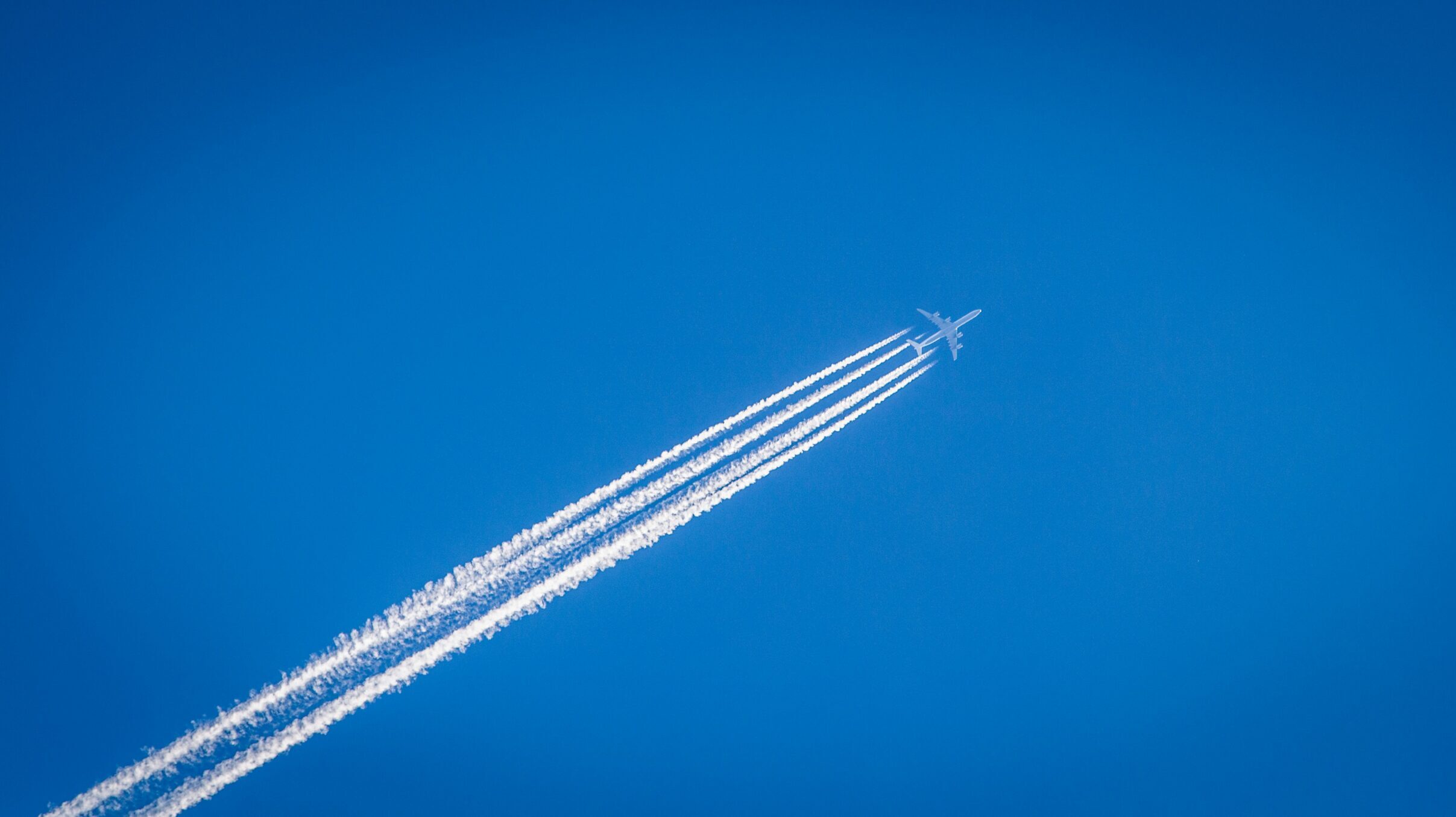
Research shows we now know enough to act, and the case is particularly clear for contrails. There is no doubt these contribute significantly to aviation’s climate footprint, and that contrail avoidance – altering flight paths to avoid areas where contrails form – is an effective, and cheap, way to tackle aviation’s non-CO2 impacts.
Our recommendations
That’s why we’re proposing that, in the upcoming revision of the EU ETS, the EU should introduce a fee on airlines unless they act on their contrail impacts. As airlines continue to claim that science is too uncertain to address non-CO2 impacts, it’s evident they will not act unless policy steps up.
James Kershaw, Scientific Officer, says:
“For too long, aviation has avoided paying for, or acting on, the full extent of the climate damages it is responsible for. While airlines face no costs for their non-CO2 impacts, communities across Europe and elsewhere are increasingly burdened by the resulting climate damages. Research shows that the biggest risk associated with contrail avoidance is not implementing it soon enough: it’s high time the EU steps up with a policy to hold airlines to account and spark the action we urgently require.”
The scale of the problem
- Flights departing Europe emitted 140m tonnes of CO2 in 2023, roughly the same as the annual emissions of the Netherlands.
- Non-CO2 climate impacts, including from contrails and nitrogen oxide (NOx) emissions, can be twice as damaging on short timescales.
What’s covered in the briefing?
- An outline of the scale of EU aviation’s non-CO2 climate problem, the existing regulatory and policy gap, and the benefits of contrail avoidance.
- Our proposal to charge airlines a fee unless they act on their contrail impacts.
- Details on how the fee would operate in practise, what action airlines would have to take to avoid the fee, and how these exemptions would be phased out over time.