
- Latest study finds that profits from 10 of the world’s largest public reporting shipping companies have nearly doubled from 2023 to 2024.
- At the same time, due to shipping’s privileged tax regime, those companies paid an effective tax rate of just 11.9%.
- Had these 10 shipping companies paid the same taxes as other companies do in their home countries, $4.3bn more in tax would have been collected – enough to provide 28m people with food aid, every day, for an entire year.
(13 April 2026)
New figures, released today from climate change NGO Opportunity Green in its latest report Global shipping 2024: mega profits, micro taxes, show the extraordinary scale of the profits being made by leading shipping companies in 2024. Ten of the world’s largest public reporting companies alone made profits of $42.9bn in 2024 – almost double the previous year.
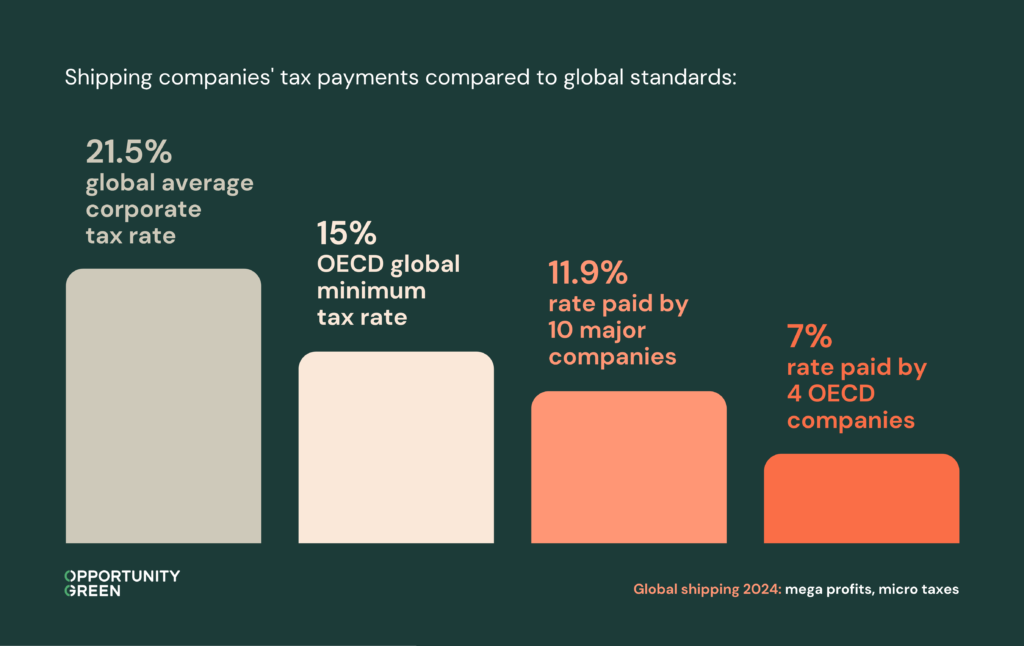
Yet despite these record earnings, shipping company taxes have remained catastrophically low and many of the world’s biggest shipping companies are failing to pay their fair share. The 10 companies assessed here paid only US$5.1bn in taxes in 2024, amounting to an effective tax rate of just 11.9%. This is far below the global average corporation tax rate of 21.1%, and below even the Organisation for Economic Co-operation and Development (OECD) global minimum tax rate of 15% (from which international shipping is exempt).
This year’s report finds that, had these 10 shipping companies paid the same taxes as other companies do in their home countries, $4.3bn more in tax would have been collected – enough to provide 28m people with food aid, every day, for an entire year. And the problem is worst in the largest and most profitable companies, with all but one of the top 10 from high income developed economies and four of those headquartered in wealthy OECD member states.
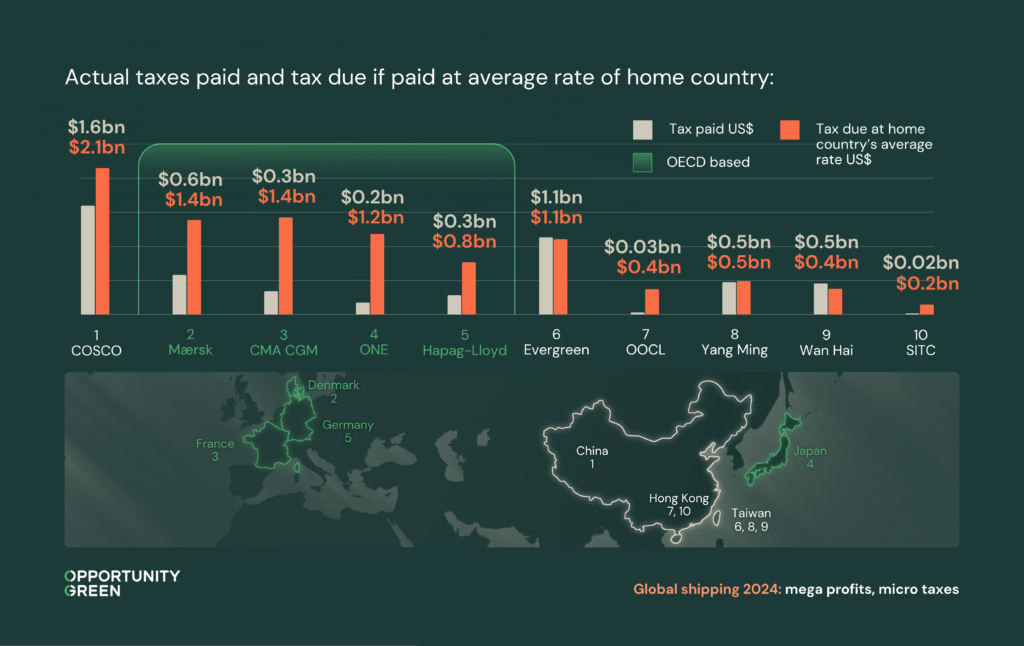
These four companies – A.P. Møller – Mærsk A/S (Mærsk, Denmark), CMA CGM SA (France), Hapag-Lloyd AG (Hapag-Lloyd, Germany) and Ocean Network Express (Japan) – make up the majority of lost taxes. They paid an average effective tax rate of just 7.0% in 2024, which amounts to a tax break of $3.4bn compared to if they had paid the average corporation tax rate in the country of their headquarters.
The scale of profits and low tax rates enjoyed by the industry stand in stark contrast to its climate impacts. Shipping is responsible for 3% of global greenhouse gas (GHG) emissions, roughly equivalent to the entire emissions of Japan – and unless urgent action is taken, this could rise to 10% by 2050. In a new addition to the report this year, Opportunity Green looks at two case study companies – Mærsk and Hapag-Lloyd – and assesses how they are spending their profits on decarbonisation. It finds that both companies report expenditures against the EU Taxonomy. While the Taxonomy is designed to identify whether economic activities align with environmental goals, in reality it allows for investments in non-solutions like Liquefied Natural Gas (LNG) to be counted towards decarbonisation, making it difficult to understand what level of investments made by these two companies are truly sustainable.
James Kershaw, Scientific Officer at Opportunity Green says:
“The level of inequity between the micro taxes paid by 10 of the world’s largest shipping companies compared to the mega profits they are making is absurd. It is effectively a case of double the profits but still only half the tax. These companies – mostly headquartered in high income developed countries – are profiting from pollution which disproportionately impacts the world’s poorest. Our new figures illustrate, in stark terms, how these companies can and should pay a fair rate of tax that is proportionate not only to other companies in their home countries, but also to their climate impacts.”
Aoife O’Leary, CEO and Founder of Opportunity Green says:
“As we have seen with recent events in the Middle East Gulf, external factors, like war or climate change greatly affect the shipping industry. While it is too early to say how the current war in the Gulf will affect shipping company profits, freight revenues often surge at times like this, and, as our new analysis shows, it is the very large companies that tend to benefit most by reaping in higher revenues. Unfortunately, the rising profits do not reflect the commercial innovation or technological breakthrough we need to see from these companies – and our research into Mærsk and Hapag-Lloyd also suggests that these profits may not materialise into meaningful investments into decarbonisation either.”
ENDS
Notes to editors
Download the report in full here.
Media can access and download the report graphs and infographics here.
This is the second report of its kind – last year’s report revealed that the world’s largest shipping companies had made more than $300bn in profits over the five years from 2019 to 2023, but paid only $30bn in taxes, an effective rate of less than 10%.
Have the companies responded to the findings?
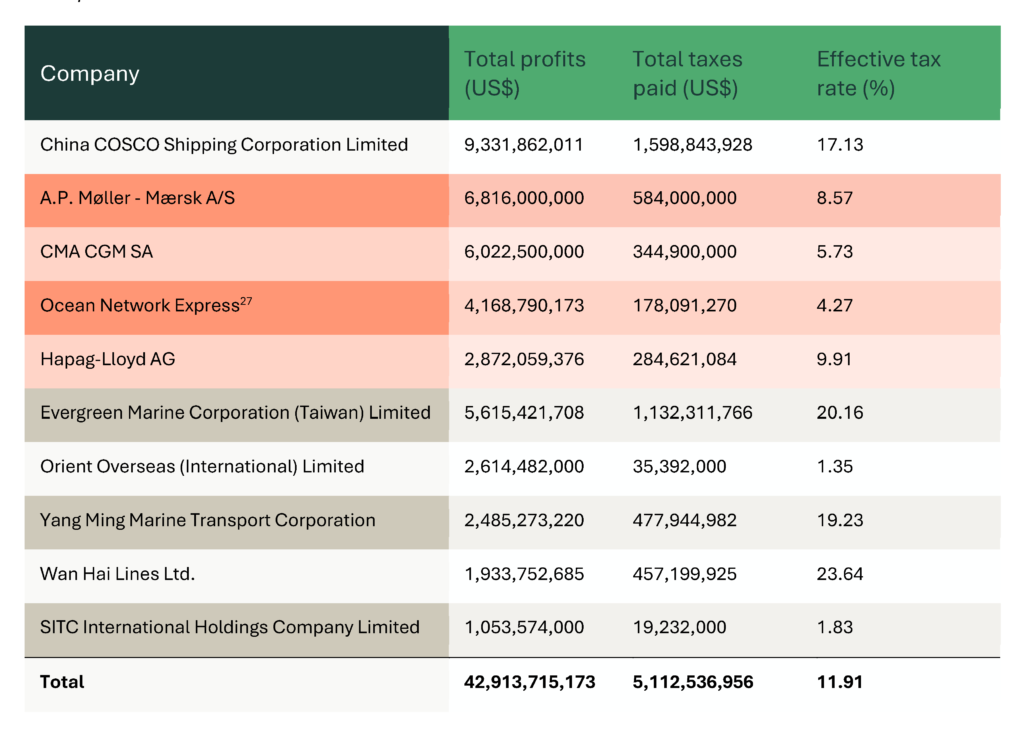
The 10 major publicly listed shipping companies assessed are China COSCO Shipping Corporation Limited, A.P. Møller – Mærsk A/S, CMA CGM SA, Ocean Network Express, Hapag-Lloyd AG, Evergreen Marine Corporation (Taiwan) Limited, Orient Overseas (International) Limited, Yang Ming Marine Transport Corporation, Wan Hai Lines Ltd and SITC International Holdings Company Limited.
All 10 companies were contacted for their responses to the figures in the report. Of these Hapag-Lloyd and Ocean Network Express responded. Hapag-Lloyd provided updated profit and tax figures which are used throughout the report. An Ocean Network Express company spokesperson stated that “The figures referenced in your… [report] do not reflect ONE’s tax position. Ocean Network Express operates in compliance with applicable tax regulations in jurisdictions in which we have a presence. We take our legal and compliance obligations seriously and are committed to meeting all requirements in the markets where we operate.” We did not receive replies from the remaining top 10 companies.
Both Mærsk and Hapag-Lloyd were also approached for comment on whether their Taxonomy-aligned capital expenditure included investments in LNG. Mærsk did not respond, while Hapag-Lloyd’s response did not address this issue in further detail.
The world’s largest shipping company at the time of writing is MSC, a privately-held Swiss company that does not publish its accounts. To provide a first-order estimate of the magnitude of MSC’s profits, we extrapolate the relationship between company profits before tax and container capacity for the 10 publicly listed companies considered here. Our estimate suggests MSC would have made roughly $10bn in profit in 2024, taking the total annual profits made by the companies assessed here to $53bn. In response to our request for comment, MSC stated that “any estimations derived from proxies, peer comparisons, or capacity-based assumptions—however sophisticated—remain speculative in nature and do not reflect MSC’s actual financial or tax situation. We would observe, in general terms, that the diversity of operating models across the container shipping industry makes cross-company extrapolations a particularly uncertain exercise. Conclusions drawn on such a basis should, in our view, be cautiously presented.”
The table below shows the total profits of the top 10 companies, the total they paid in tax and the effective tax rate they paid, over 2024.
The International Maritime Organization (IMO) and a shipping levy
Discussions at the International Maritime Organization (IMO) on reducing shipping’s climate impact culminated in the agreement of the IMO’s Net Zero Framework (NZF) in April 2025. This included a GHG emissions pricing mechanism, which is initially expected to generate $11-12bn each year, a modest amount compared to the more than $40bn in 2024 profits we report here. To put the expected IMO NZF revenues in context, the missing taxes of $4.3bn from these top 10 companies alone would cover more than 30% of this amount.
Although the NZF had been expected to be adopted, it was delayed by at least one year in October 2025. While it remains to be seen whether the NZF will be adopted in 2026, the profits and tax rates highlighted in this report illustrate clearly the ability of the industry to start paying more for its climate impacts.
Why is shipping exempt from OECD tax rules?
Following intense industry pressure, the OECD granted shipping companies an exemption from its minimum corporation tax rules, which applies a global minimum corporation tax of 15%.