
(9 September 2026, Brussels)
- Ryanair and Lufthansa, plus four other of Europe’s biggest airlines, received €6bn alone
- Free allowances very likely contributed directly to €21bn profits for the six major airlines
A major report released today by climate change NGO Opportunity Green and independent research and consultancy CE Delft reveals the extent to which airlines have been handed free giveaways under the EU’s flagship cap-and-trade carbon market, the Emissions Trading System (ETS).
New data shows that between 2013 and 2025, the EU handed €10.9bn in free allowances to European airlines – yet they have not passed the savings on to consumers, made few genuinely sustainable investments to help secure the industry in the long term, and likely made bigger profits as a result.
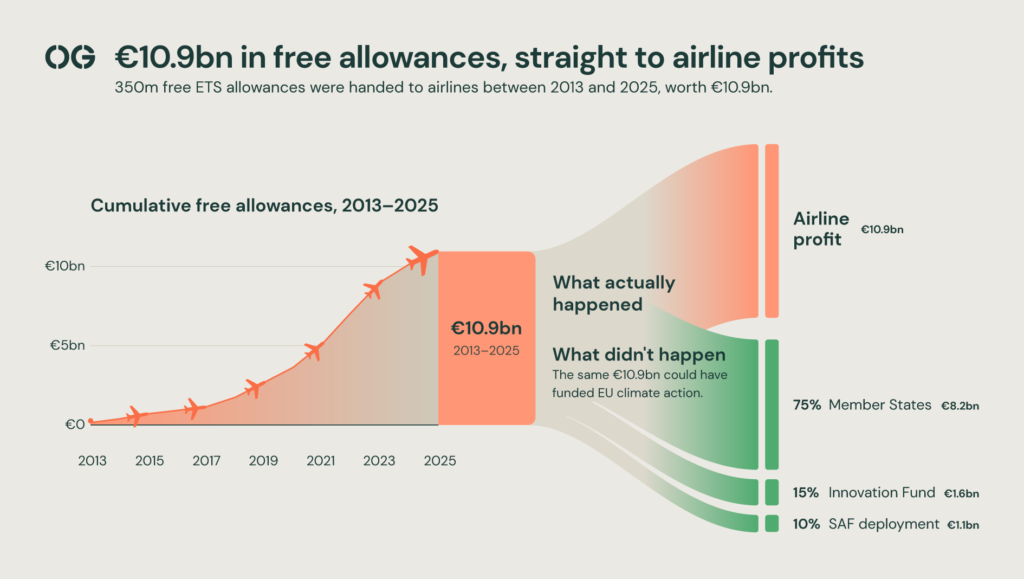
Six of Europe’s biggest airlines – Lufthansa Group, Ryanair, easyJet, IAG, Air France-KLM and Wizz Air – received €6bn alone, while making €21bn in profit. Meanwhile, they have contributed a pittance towards sustainable activities, racking up €320bn of climate costs, while spending only €1bn on decarbonisation. Of these six major airline groups’ total capital investments, the report estimates that just 0.1% supported genuinely sustainable investments in 2025.
Tom Grylls, Director of Analytics at Opportunity Green, says:
“Airlines are not the victim they like us to think they are when it comes to profits and competition. These figures show that the industry’s narrative about airlines struggling to remain competitive is greatly overblown. In reality, they have enjoyed years of freebies, and instead of funding climate action through new innovations in sustainable technology or SAF deployment, this money simply turned to profit and lined the airlines’ deep pockets.”
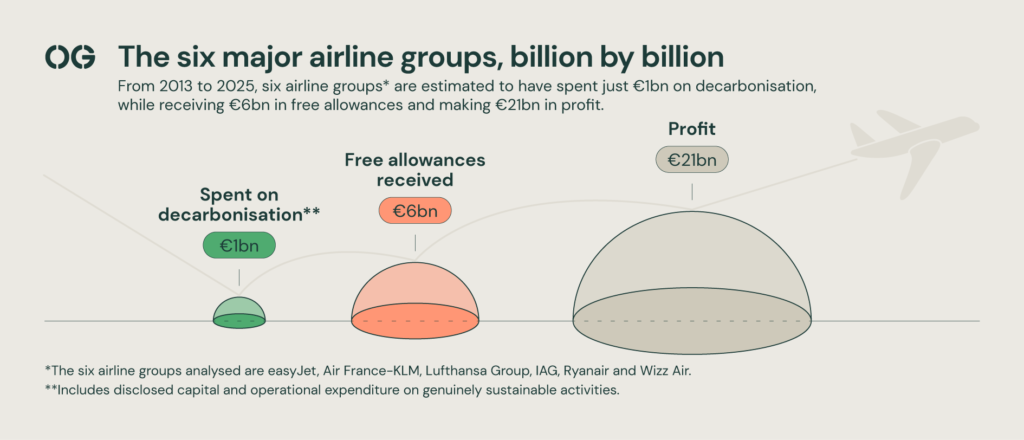
The €1bn that was spent between 2013 and 2025 on genuinely sustainable decarbonisation activities (e.g. sustainable aviation fuel purchasing and ground-equipment electrification) stands in astonishing contrast to €13.7bn of finance for aviation classified under the EU’s Sustainable Finance Taxonomy.
This staggering discrepancy has come about due to weak criteria set out in the Taxonomy, where new planes running on fossil fuels are allowed to be labelled as ‘sustainable’. This directs investment to planes that will pollute the climate for decades to come and provides more incentives for the aviation industry to continue to dodge paying for its pollution.
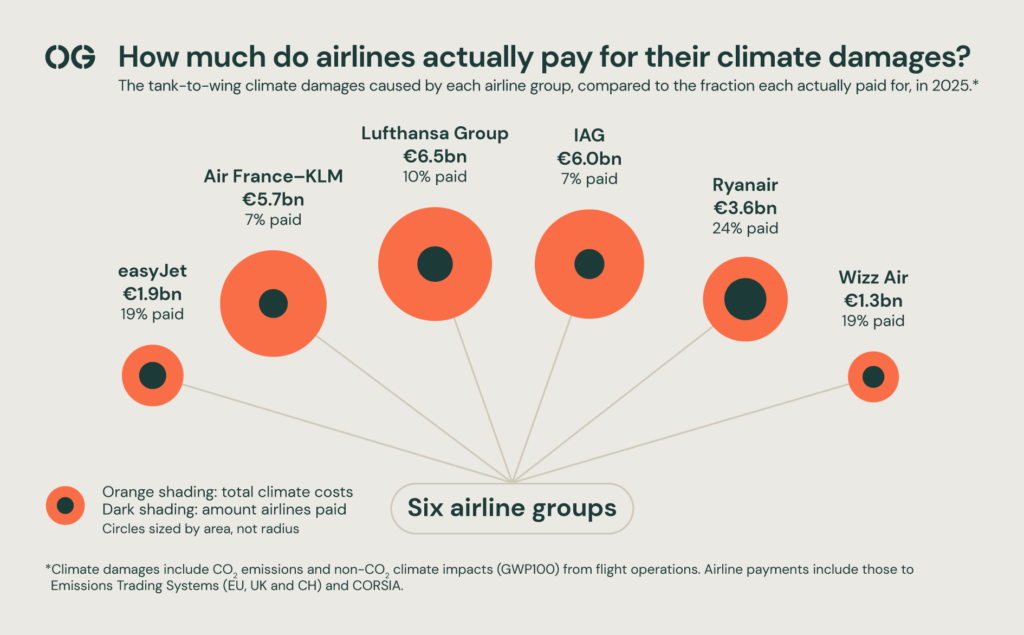
Airlines have long benefited from unfair tax exemptions, with other sectors left to cover the cost. The EU ETS has reinforced this by exempting international flights – a gap that cost around €26bn in lost revenue between 2012-2023. In 2025, Lufthansa, RyanAir and four other airlines collectively paid for just 12% of the climate costs they caused, benefiting from free allowances and policy gaps on international flights and contrails.
This summer’s EU proposals to reform the ETS offered a chance to price aviation’s full climate impact by bringing international flights into the scheme. That opportunity has been missed: the Commission proposes covering only flights within 5,000km of Frankfurt, starting in 2029, exempting major markets like the US and China and leaving the most polluting long-haul flights with no incentive to decarbonise.
Carly Hicks, Chief Strategy and Impact Officer at Opportunity Green, says:
“The history of free allowances tells us that if airlines aren’t compelled to act on decarbonisation, they won’t. Under latest proposals for the EU ETS, any allowances for aviation are conditional upon sustainability criteria, such as using alternative fuels or mitigating contrails. It’s crucial that the EU Commission sticks to this pathway, and ensures the criteria are ambitious, even if the industry ends up asking for more free allowances.”
Based on the findings in the report, Opportunity Green is making these recommendations to the EU Commission:
- Free allowances are an ineffective tool to tackle competitiveness and a barrier to progress on climate change. Future revisions of the EU ETS for aviation must not include free allowance allocations.
- The ETS must be expanded to cover all flights departing from Europe.
- Europe should take action on aviation’s non-CO2 climate impacts, by charging airlines a fee unless they take action to avoid contrails.
- The EU Taxonomy should be abolished completely or reformed to adopt a stronger definition of sustainability, which must exclude investments in fossil-fuelled aircraft.
ENDS
Notes to editors
- Read Opportunity Green’s briefing
- Full in-depth report by CE Delft
- Visuals from the report available to download and reuse here.
We wrote to the six airlines with our findings. We received three responses, detailed in full in the report summary. In short:
- IAG responded to highlight their view that “the limited scope of the EU Taxonomy Regulation does not enable the Group to outline all of our investment activity in our Flightpath Net Zero transition”.
- Lufthansa Group stated that they were “unable to verify the figures and conclusions presented in your email”.
- easyJet responded that while they were “not in a position to validate the accuracy of the figures presented,” [they would] “like to highlight that we’ve committed substantial capital in support of operational and industry decarbonisation within the stated reporting period”.
- Ryanair, Air France-KLM and Wizz Air did not respond.