What alternative fuels and energy sources exist for shipping and aviation?
Alternative fuels largely fall into two categories: ‘biofuels’ produced from biological material; and those from non-biological origin, called synthetic fuels or e-fuels. Fuels described as “drop-in” can be used in existing engines (just as fossil fuels currently are) and do not require changes to maritime vessels or aircraft.
Then there are alternative non-fuel energy sources like battery electric ships and planes, or alternative propulsion systems like wind power.
There is no silver bullet for either sector, and different solutions may be more appropriate in different circumstances, for example depending on the distance of the journey. Nevertheless, some solutions have greater potential to cut shipping and aviation emissions at scale than others. There are even some so-called “solutions” that would actively hinder or derail the transition.
How can we compare these alternative fuels and energy sources?
When evaluating an alternative to maritime and aviation fossil fuels, there are a few factors to consider.
- Greenhouse gas emissions
To understand a fuel’s climate impact, emissions must be accounted for (1) from all greenhouses gases (not just carbon dioxide), and (2) across each fuel’s entire lifecycle.The fuel’s ‘lifecycle’ doesn’t just include the emissions released when combusted, but also those emitted during upstream phases like production, storage, and transportation.
- Environmental impacts
Even if a fuel doesn’t have a direct global heating effect, the emissions or chemicals released may harm the environment by damaging ecosystems and biodiversity or destabilising planetary systems. These environmental changes often cause subsequent increases on temperature. - Justice, equity and human rights
The transition away from maritime and aviation fossil fuels must be guided by principles of justice, equity, and respect for human rights. The climate crisis is fundamentally unjust, with the communities least responsible for causing it often those most vulnerable to its devastating consequences. And this is true too for shipping and aviation: developed countries benefit from the vast majority of global shipping profits and 1% of the global population is responsible for half the aviation industry’s emissions, while 80% have never flown.Shipping and aviation’s transition must help correct rather than perpetuate these inequities. This means ensuring developing countries are supported in their transitions and can benefit from the economic opportunities the transition offers, while safeguarding human rights, energy security, food security and resource sovereignty across all relevant supply chains.
- Economic cost
Alternative maritime and aviation fuels are currently more expensive than conventional fuels, and the more sustainable choices are often costlier and less technologically developed. However, when measuring the price difference between fossil and sustainable fuels it is important to factor in the social cost of carbon expected from continued fossil fuel use.Governments can help sustainable fuels compete with fossil fuels through stronger policy. This can involve targeting financial support to research and development and early-stage technology developers, and taxing fossil fuels to make sustainable alternatives more competitive and raise funds to support sustainable alternatives.
- Resource use and scalability
Not only should a fuel be sustainable and affordable, but it should also be feasible to produce at scale in the long term.Every material resource, be it oil, gas or biomass, has a finite limit and cannot be relied on as a fuel feedstock forever. The more a fuel can be produced with renewable energy, therefore, the more likely it can be produced at scale without overexploiting resources to the detriment of planetary systems.
- Health and safety
Fossil fuels don’t only harm the planet’s health, but humans’ too. Aviation and shipping pollution impacts public health, particularly in and around ports and airports, and workers’ personal health and safety may be put at risk from certain fuels and chemicals. Whatever energy systems are chosen should be accompanied by regulations to mitigate any health and safety risks wherever possible.
Alternative fuels and energy sources for shipping
Direct electrification
Electrification should be the alternative energy path of choice for any sector, and shipping is no exception. An electrified vessel can be zero emission if powered by renewable electricity. With today’s technology, battery-electric ships may only be able to serve short voyages, whereas long-haul shipping requires alternative fuels.
Wind-assisted propulsion systems (WAPS)
Retrofitting vessels with sails can reduce fuel consumption by as much as 20%. WAPS will therefore be a crucial technology not just for reducing short-term emissions but also reducing demand for alternative fuels as the maritime energy transition develops, making adoption of alternative fuels more feasible for the industry.
Hydrogen propulsion
Hydrogen is the basis for many alternative fuels, either used directly or combined with carbon or nitrogen in e-fuels. Zero-carbon ‘renewable’ or ‘green’ hydrogen can be produced using via water electrolysis.
Hydrogen can be stored in a liquid organic hydrogen carrier (LOHC) and burnt in a conventional ship engine. It can also be stored at extremely low temperatures, increasing energy density and allowing the ship to travel greater distances, but then requires novel technology to be used.
Liquified natural gas (LNG)
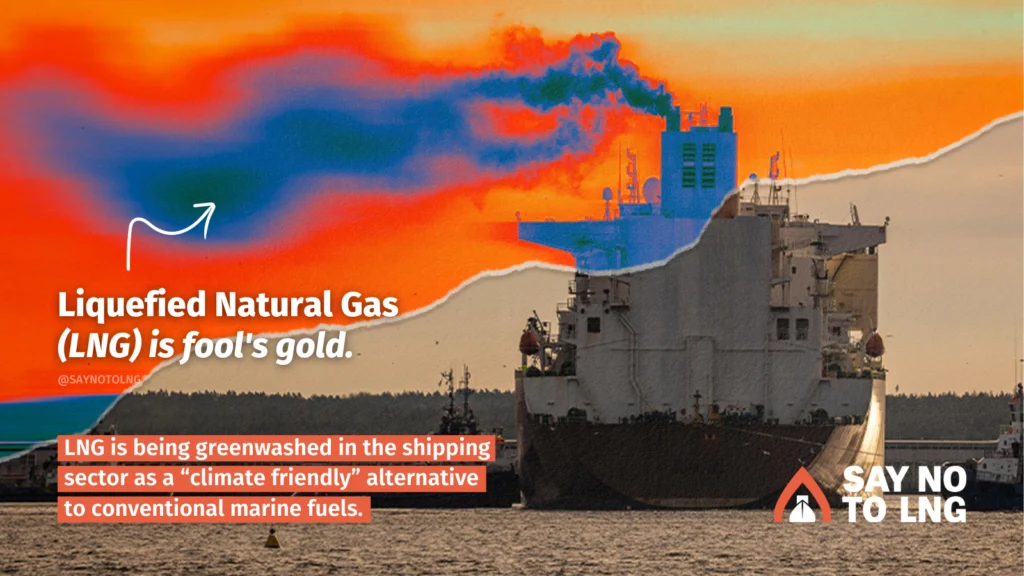
Fossil LNG is widely touted as a so-called “transition fuel”, to cut GHG reductions in the short-term while more sustainable fuels are not yet commercially available. This approach is often supported by the claim that LNG emits 40% less CO2 than coal. Looking at LNG on a full lifecycle basis and accounting for all GHGs, however, tells a different story.
LNG consists mainly of methane, a potent GHG with climate impacts 80 times greater than CO2 over a 20-year period. Methane leakage and slips across the supply chain means fossil LNG has an estimated GHG footprint 33% greater than coal over a 20-year time frame.
The transition argument is also un-pragmatic, since it involves investing in assets that will likely lock in LNG, seriously delaying the transition to truly sustainable fuels and ultimately exposing industry actors to financial risk.
Despite its growing popularity in the maritime industry, fossil LNG is not a fuel that can align the sector with the 1.5ºC Paris Agreement temperature goal.
Learn more about LNG in our report, (Un)sustainable from ship to shore.
E-LNG or e-methane
E-LNG, also known as ‘renewable LNG’ or e-methane, is a synthetic version of fossil LNG produced with renewable hydrogen and a source of captured carbon.
While synthetic fuels do have the potential to be the lowest-emission alternative fuels, the risk of methane slip remains. If 100% of EU shipping fuel had been e-LNG between 2019-2030, methane emissions would still have doubled. If e-LNG is to play a role in the future maritime fuel mix, it will depend on technological development to drastically minimise methane slip, and more stringent regulations.
Biofuels
Biofuels are produced from biological material, or biomass. Neither offers a path to decarbonising shipping at scale without environmental damage. In fact, aiming to decarbonise Europe’s ships and planes with biofuels could completely undermine the EU Nature Restoration Regulation by 2050.
Advanced or waste-based biofuels are produced with used cooking oils, waste animal fats, and agricultural resides. These release fewer emissions than conventional fuels but are in short supply. There is also competition between sectors to access these scarce feedstocks, meaning their prices will likely increase. Biofuels may also cause indirect emissions by displacing bio-feedstocks from other more sustainable uses. Furthermore, high levels of fraud in biofuels imported to Europe means that supposedly waste-based fuels are often mislabelled palm oil.
Crop-based biofuels are not sustainable. Producing them may incentivise deforestation, ecosystem damage and food system disruption. Accounting for indirect land use change (ILUC) emissions, certain biofuels such as palm oil may emit three times as much CO2 as the fossil fuels they replace.
Learn more about biofuels in the SASHA Coalition’s report, How e-fuels can mitigate biodiversity risk in EU aviation and maritime policy.
E-ammonia
Since ammonia does not produce CO2 when burnt, it is often assumed to automatically be a sustainable marine fuel. However, the ammonia lifecycle may involve the release of CO2 and nitrous oxide (N2O), a GHG with a warming effect 273 times greater than CO2. There may also be hydrogen and reactive nitrogen leaks causing negative public health, environmental and biodiversity impacts.
To truly reduce lifecycle CO2 emissions, ammonia fuels must be produced with renewable hydrogen – e-ammonia. And, regulation needs to be put in place to stringently monitor and minimise the release of all other GHGs.
Learn more about ammonia in our report, Ammonia as a shipping fuel.
E-methanol
E-methanol is currently the most advanced marine e-fuel, and presents a viable long-term solution. As of August 2025, there are around 60 methanol-capable vessels on the water, with over 300 more on order, and nearly 20 ports offering methanol bunkering.
When produced with renewable hydrogen, e-methanol can reduce shipping GHG emissions by as much as 94% compared to fossil fuels, and may be the only scalable drop-in fuel compatible with both climate and biodiversity goals.
Alternative fuels and energy sources for aviation
When people think about flying green, so-called ‘sustainable aviation fuels’– or “SAF” – often comes to mind. SAF is an umbrella terms referring to a range of drop-in fuels, but in reality, some of these fuels are much less sustainable than others. In fact, advertising alternative fuels as “SAF” may carry legal risks in consumer and financial markets.
Beyond these alternative fuels, novel aircraft technologies are also expected to play an important role in decarbonising short- and medium-range flights.
Biofuels
The most popular drop-in alternative aviation fuels are biofuels, which face the same challenges as marine biofuels.
Advanced, or waste-based, biofuels, made from organic waste such as used cooking oils, forestry residues, municipal waste and animal fats, can reduce CO2 emissions by up to 77% compared to fossil kerosene.
Crop-based biofuels, made from plants like corn, soy, sugarcane, miscanthus or oilseed, can reduce emissions by 55% but also raise them by 13%, depending on the production pathway, and emissions caused through indirect land use changes (ILUC).
E-kerosene
E-kerosene, or synthetic fuel, has the potential to be the lowest emission drop-in aviation fuel. If produced with renewable hydrogen and a sustainable source of carbon it can reduce CO2 emissions by up to 98% compared to fossil kerosene.
The technology is still nascent and producers have struggled to scale up production, a necessary step for reducing costs. This is because high project costs and undue support for fossil fuels and unsustainable biofuels limits access to investment. Very little e-kerosene is currently commercially available.
Read more in the SASHA Coalition and Climate Catalyst’s Investor’s guide on the just transition, social and environmental considerations of the aviation fuel transition.
Battery electric planes
As ever, the ideal approach to cutting emissions is electrification – electrified planes can be almost completely zero emission on a lifecycle basis. Electrified planes are being developed but are not yet commercially available. With existing technology, flight times are limited and new aircraft models and infrastructural modifications at airports are necessary.
Hydrogen propulsion flying
Propulsion systems that can run off renewable hydrogen are being developed for low emission, short- and medium-haul flights. There are two types of hydrogen propulsion flying, both requiring novel aircraft models.
Hydrogen fuel cells convert liquid hydrogen to electrical energy, producing no tailpipe GHG emissions. They do however release some water vapour, and may involve slippage of hydrogen, itself a potent GHG. These aircraft are expected to transport around 100 passengers at a range of just over 1,800km (London to Sicily),
Direct combustion of gaseous hydrogen in modified jet engines produces zero CO2 but does release nitrogen oxide (NOx) GHG emissions. This approach is expected to be able to carry 120-150 passengers around 2,600km (London to Istanbul).
Read the SASHA Coalition’s policy briefing, Leading the race to zero carbon emission flight.
Learn about our approach to promoting the most sustainable alternative fuels.