Why is flying bad for the environment?
It’s no secret that flying is not climate friendly, but the full extent of air travel’s impact on the planet is far greater than many realise.
In fact, taking a long-haul flight is the single most environmentally-damaging activity an individual can do. The average flight releases roughly 0.3kg of CO2 per passenger per kilometre. This is about 10 times as much as the average UK train, and 100 times as much as high-speed trains like the Eurostar.
Globally, aviation accounted for 2.5% of global CO2 emissions in 2019. That number may sound small, but it is roughly the same as the total emissions of Germany or Japan. Accounting for flying’s non-CO2 climate impacts, aviation’s total share of planetary heating to date probably reaches 4%.
Who flies the most?
Right this second, there may be as many as 1.2 million people in the air. But who are they?
Around 4% of the world’s population flew internationally in 2018, while around 80% of people have never even been on a plane. What’s more, only 1% of the global population is responsible for half of aviation emissions.
Private jets may account for only around 2-2.5% of total aviation emissions, but are the most carbon intensive form of flying – and therefore of any mode of transport (apart from space travel). Private jets are mainly flown by the richest 0.003% of the adult population with a combined wealth of $31tn. And yet private flights often face a far lower effective tax rate: for a London to Paris ticket, only 2% of the price is paid in tax on a private jet versus 43% for economy class.
How does flying damage the climate?
CO2 emissions
Flying largely accelerates global heating through the carbon dioxide emissions released when jet fuel is combusted. CO2 accounts for around 55% of aviation’s global warming contribution. It can remain in the atmosphere for over 1,000 years, and will keep warming the planet for the full extent of this time.
Non-CO2
CO2 isn’t aviation’s only climate problem. Non-CO2 impacts, from contrails and NOx emissions, are estimated to be at best equally as damaging as aviation’s CO2 impacts. At worst, they may be twice as damaging.
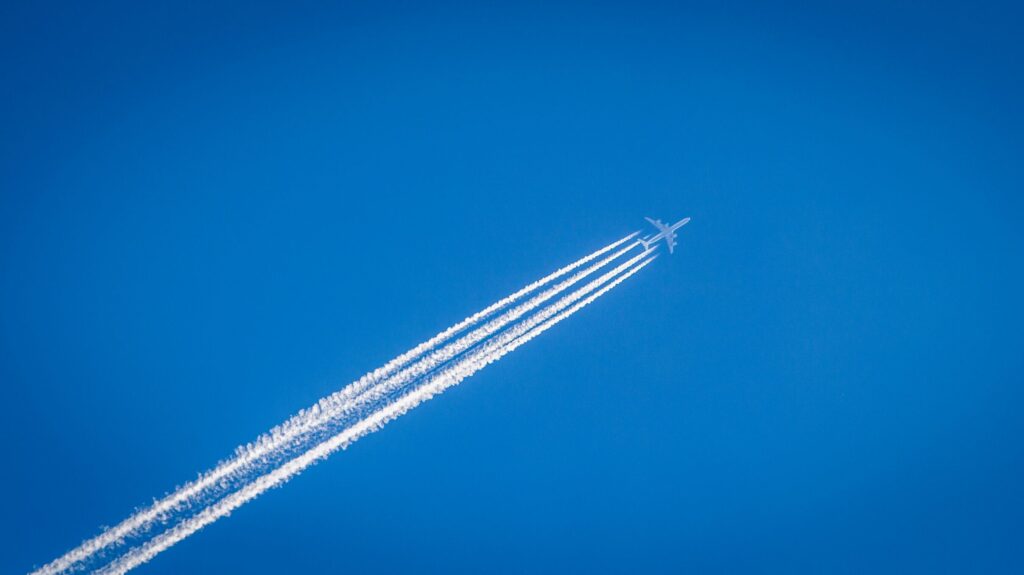
- Contrails are the white streaks of cloud left behind planes. They form when water vapour and soot from plane exhausts form ice crystals that become clouds, which reflect solar radiation and trap heat in the atmosphere. Contrail formation depends on factors including aircraft engine characteristics, fuel composition, and air temperature and humidity.
- NOx emissions cause chemical reactions in the atmosphere which lead to increased ozone production.
While we don’t have enough data to know the full magnitude of non-CO2 impacts, we do know that they must be mitigated, and how to do so effectively and cheaply.
Find out more in our guide to controlling contrails.
Are aviation emissions coming down?
The short answer is no. Flying has become more energy efficient, meaning fewer emissions are released per passenger kilometre, but these improvements have been outpaced by the sector’s rapid and continuing growth.
International aviation is on track for well over 4ºC warming above industrial levels. This scenario would see radically disrupted global food and water systems, ecosystems and rampant extreme weather events, and the average individual up to 40% poorer.
Without transformative change, by 2050 the sector could still be releasing over 16 times more emissions than what it needs to in order to stay under 1.5ºC.
How can we reduce flying’s impact on the environment?
Adopting alternative aviation fuels and technologies
There are a range of different alternative aviation fuels, such as biofuels, hydrogen and e-kerosene some more sustainable than others, as well as novel technologies that produce no carbon emissions during flight.
Learn more on our alternative fuels and technologies page.
Avoiding contrails
Contrails can be avoided easily and cheaply. Since contrails form in certain air temperatures and humidities, planes can be rerouted to avoid such conditions, by flying at different altitudes and times of day.
Only about 14% of flights in 2019 caused climate-warming contrails at all, and 2% of flights were responsible for 80% of contrails. Rerouting these few flights that produce the majority of contrails is estimated to cost between $0.50 and $14.00 per tCO2e. By contrast, using alternative aviation fuels to reduce flying’s impact costs at best $185 per tCO2 equivalent.
Nevertheless, aircraft operators do not yet face binding obligations to reduce their contrails.
Read more in our report Contrails: A policymaker’s guide to reducing aviation emissions.
Improving energy efficiency
Improving energy efficiency is an important piece of the energy transition, but is not the whole picture. More efficient technologies reduce the emissions produced per unit of fuel burnt, but won’t eradicate pollution altogether. Indeed, air travel demand has outpaced efficiency gains: since 1990, flying has become twice as efficient but emissions have still doubled.
However, improving energy efficiency is still important. Even the most sustainable fuel has some environmental impact across its lifecycle, so reducing demand is positive. It also reduces costs, helping the uptake of more expensive sustainable fuels.
Changing how much we fly
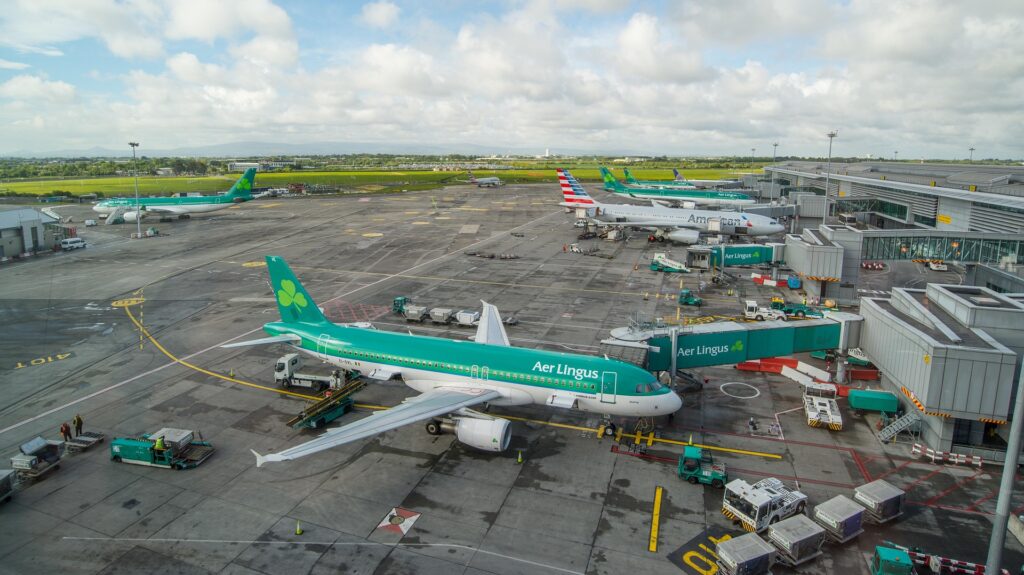
Plans to expand airports have been approved across Europe and the UK, including at London’s Heathrow, Gatwick and City airports, and airports in Dublin, Amsterdam, Florence, Frankfurt, Athens, and Heraklion. This means more passengers, more flights, and more emissions.
Governments justify expansion on the basis that it grows the economy, but research shows that this is only true in certain situations.
The cleanest flight is undoubtedly the one you don’t take – but how can we reduce demand for flying? Firstly, we need governments to invest in affordable, efficient and accessible alternative transport means to flying. The Sail & Rail scheme between England and Ireland, for instance, is much less carbon intensive than flying, yet the ticketing system presents a barrier to consumers choosing this route over air travel.
Secondly, aviation should be properly taxed. Aviation has long enjoyed a privileged tax regime, paying neither standard nor climate taxes as other sectors do. Air travel levies (national taxes applied per passenger per flight) are now relatively common, but some countries still hold out, like Ireland.
International law: who is responsible for planes’ pollution?
Aviation emissions either come from domestic flights (between two airports in the same country), or international flights (between two different countries). Regulating domestic flight emissions is clearly the responsibility of the country in question. But who reduces international aviation emissions?
The International Civil Aviation Organization (ICAO)
ICAO is the UN specialised agency for regulating international aviation. While some claim that ICAO (and not states), is responsible for international emissions, the truth is that states are legally obliged to reduce this pollution, despite ICAO.
ICAO also lacks inclusivity and transparency, with developing countries underrepresented and research pointing to corporate capture.
The body’s flagship climate measure, the Carbon Offsetting and Reduction Scheme for International Aviation (CORSIA), has long been proven inadequate relative to the Paris Agreement temperature targets.
States
States are legally obliged under the Paris Agreement to take all means necessary to address climate change across their economies. This means that states are responsible for international aviation emissions regardless of ICAO, and particularly since ICAO’s policies do not align international aviation with the Paris Agreement temperature targets.
This legal interpretation has been reinforced in the Advisory Opinions released by International Tribunal for the Law of the Sea in 2024, and the International Court of Justice and Inter-American Court of Human Rights in 2025.
Policy and regulation: what is being done to reduce flying emissions?
There are many ways that policy addresses aviation’s climate impacts. Below we list the areas that Opportunity Green focuses on.
Setting targets
- In 2022, ICAO Member States adopted the ‘long-term global aspirational goal’ (LTAG) of net-zero carbon emissions by 2050. However, the LTAG comes with no obligations on member states, does not set interim targets, and fails to account for non-CO2
- The European Union’s aviation targets are bound up in the 2019 European Green Deal that sets a legally binding target to become climate-neutral by 2050, with interim goals of at least 50% by 2030, rising towards 55%. As part of this framework, transport emissions must be reduced by 90% by 2050 compared to 1990 levels.
- The UK’s Jet Zero Strategy published in 2022 aims for net zero aviation by 2050 with interim targets in 2030 and 2040, although these are not legally binding.
Transitioning to alternative fuels, energy sources and technologies
Once targets are set, authorities put in place measures for achieving them, which largely involves transitioning from fossil jet fuel to alternatives.
- ReFuelEU Aviation – the EU’s main legislative tool for driving the aviation energy transition. Adopted in 2023 as part of the Fit for 55 package, ReFuelEU Aviation sets binding mandates for minimum levels of uptake of alternative fuels for commercial air transport, including a sub-target for the most sustainable synthetic fuels. These increase yearly to a peak of 70% in 2050.
- SAF Mandate – introduced in the UK in 2024. It is similar to ReFuelEU Aviation, but will also phase out the use of HEFA (hydroprocessed esters and fatty acids) fuels due to this alternative fuel being less sustainable.
- ICAO’s aircraft CO2 standard – requires planes to comply with a certain efficiency level. However, the average newly-built aircraft is already above the standard’s baseline efficiency level, so the policy does not effectively incentivise efficiency gains.
Putting a fair price on emissions
The ‘polluter pays principle’ is the idea that whoever is responsible for greenhouse gas emissions should pay for them rather than the public. The aviation industry uniquely benefits from a range of free passes that means it does not pay for its pollution and is not robustly incentivised to decarbonise.
The EU emissions trading system (ETS) is a market-based ‘cap-and-trade’ mechanism that requires companies to purchase allowances to cover their emissions. A certain number of allowances are released each year, and companies with more emissions than allowances pay a penalty on excess emissions. Every year, the number of allowances sold reduces, incentivising polluters to reduce their emissions to avoid penalties. Revenues are distributed to EU Member States to reinvest into climate action domestically. The UK has its own similar ETS.
Despite being largely effective, the ETS has gaps when it comes to aviation. Most significantly, the ETS covers emissions from flights between European countries, but not those between European and non-European countries. The ETS was meant to be extended to international flights in 2012, but heavy industry and state pressure led to the European Commission exempting these flights from paying for their pollution. The inclusion of international flights in the EU ETS is still missing, it has only been extended to flights within 5,000 km of Frankfurt, from 2029.
On paper, the exemption was to allow ICAO to develop a global system, CORSIA, which has since, proved ineffectual.
CORSIA has been active since 2021. Despite its global scope, the system is not effectively designed to reduce emissions. CORSIA only aims to achieve carbon neutral growth, rather than zero or net-zero emission flying. This means that it only applies to emissions above an already high baseline – and the emissions it does apply to need only be offset using carbon credits. Even if implemented in full, CORSIA would still see international aviation on track for over 4ºC warming.
CORSIA is voluntary until 2027 and then only mandatory for the 34 States with the highest shares of global aviation. It also has no enforceability mechanism, is set to end in 2035 with no plans afterwards, and ignores non-CO2 impacts.
Aviation also enjoys a free pass on standard fuel tax. It is often claimed that taxing kerosene is prohibited under international law, but there is in fact no such prohibition. Indeed, exempting aviation fuels of tax in the EU may even come into conflict with State Aid obligations and the Trade and Cooperation Agreement between the EU and UK.
|
Tax rates paid on road transport and aviation fuel in 2025 |
|||
|---|---|---|---|
|
|
EU car petrol |
UK car petrol |
Aviation kerosene |
|
Fuel duty (per litre) |
35.9¢ (minimum) |
52.95p |
0 |
|
VAT |
21.8% (average) |
20% |
0% |
|
Effective tax rate |
53.6% (average) |
54-57% |
0% |
Learn about our approach to tackling aviation’s climate impact.