
Why are data centres bad for the environment?
The explosive growth of artificial intelligence (AI) is transforming our digital world, but it comes at a cost. AI models consume huge amounts of fossil-fuel-based electricity, significantly contributing to greenhouse gas emissions. Data centres consumed around 1.5% of global electricity in 2024, according to The International Energy Agency (IEA). This figure could easily double by 2030 and is projected to increase even further in the coming years.
Demand for AI is driving rapid data centre expansion, sharply increasing energy use, emissions and environmental impacts, and placing unprecedented strain on energy systems and global climate goals.
What are data centres?
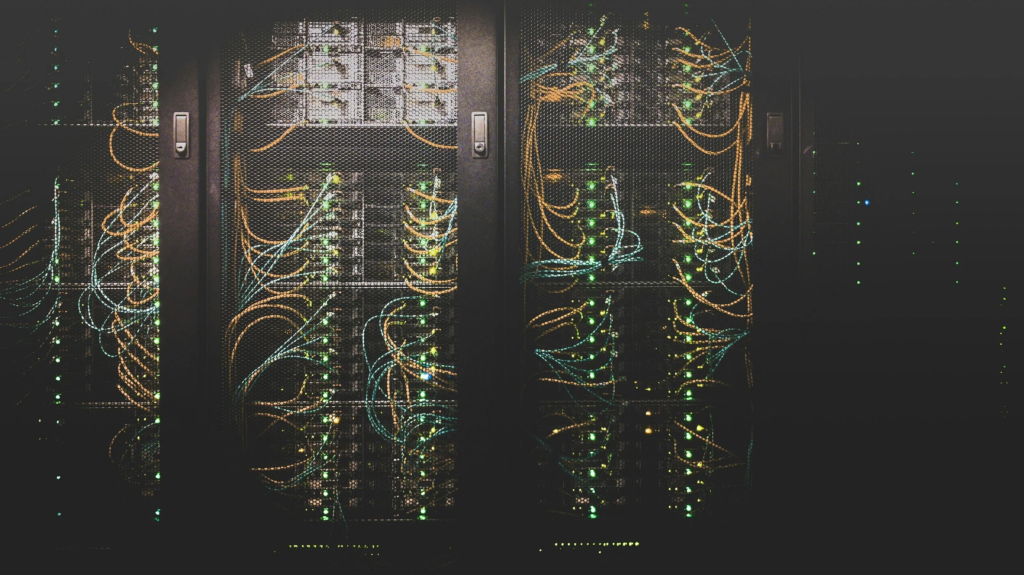
Data centres are specialised facilities containing hundreds, sometimes thousands, of dedicated servers that collect, process and transmit data. They’re the physical backbone of our digital world; without them, everything from streaming services to AI applications wouldn’t function.
Why is the environmental impact of data centres growing?
The scale and speed of expansion is intensifying data centres’ environmental impact across energy systems, water resources and climate targets.
The explosive arrival of generative AI following ChatGPT’s launch in October 2022 has dramatically accelerated demand for data processing. Large Language Models (LLMs) require vast amounts of computing power, and this surge in AI activity is driving rapid growth in both the number and size of data centres. This expansion is reshaping national energy systems as new facilities drive unprecedented electricity demand from data centres.
Read our policy briefing ‘Data centres: how soaring demand threatens to overwhelm energy systems and climate goals’.
Data centre energy consumption and resource requirements
Data centres require substantial resources. The three primary requirements are:
- Semiconductors, built from materials like silicon and copper, which provide computing power.
- Electricity, to run servers and network equipment.
- Water, to cool machines and maintain stable operating temperatures.
The level of data centre energy consumption and water use is unprecedented in modern energy systems. What does it represent in reality?
A typical hyperscale data centre (the largest size, used for AI processing) uses:
- 3-5m gallons of water per day – about the same daily consumption as a town of 40,000 people.
- 20-50 MW of power – roughly equivalent to the average domestic power consumption of 70,000 – 170,000 homes in England.
Until recently, the growth of our digital economy had relatively few implications for energy demand and therefore carbon emissions. With the arrival and rapid expansion of generative AI, that’s changed dramatically.
- A ChatGPT query requires around ten times the electricity of a typical Google search.
- Today, data centres globally use the same amount of electricity as France or Germany.
- By 2030, global data centre energy use will be comparable to that of India – a fast-growing country of 1.4bn people.
The problem isn’t uniform. Some countries face particularly acute pressures.
For example, Ireland, which has been promoting itself as a data processing centre since the late 1990s, is forecast by the IEA to have one-third of its domestic electricity production dedicated to data centres by 2026, up from 17% in 2022. Today, data centres already use more electricity than all of Ireland’s urban homes combined.
And in the US state of Virginia, the centre of the global industry with an estimated 70% of all internet traffic flowing across its borders, electricity demand could triple by 2030, far outstripping planned supply.
Data centre emissions and threats to climate goals
Data centres are responsible for at least 0.5% of global greenhouse gas emissions today. The IEA forecasts that the sector will grow to account for 1.4% of global emissions in just five years – a footprint the size of Japan. The sector’s contribution to greenhouse gas emissions is significantly larger if a whole-lifecycle view is taken, from manufacture to construction to operation.
How is this rapid rise in demand for energy being met? By a return to fossil fuels as an energy source. In the US, 60% of additional electricity demand is being met by an expansion of natural gas. Meanwhile, Germany and Poland are extending the life of coal-powered electricity generation.
Can data centres be powered by renewable energy?
In principle, data centres ought to be easy to decarbonise. No new technology is required to switch a data centre to renewable use. But in practice, much of the new demand for capacity has been met by non-renewable sources. This has significant implications for data centre decarbonisation efforts.
Currently, coal power is the largest single source of data centre electricity, at 30% of global electricity used by the sector. Renewables from all sources account for 27%, natural gas 26% and nuclear 15%.
So why has this new demand not been met by renewable sources?
There are three main reasons:
- Grid bottlenecks: sudden new demands on existing grids pose complications for connections and capacity, making rapid expansion difficult.
- Consistency requirements: data centres need continuous, stable power supply, with minimal failure rates, combined with occasional spikes during peak processing times. To meet this, renewables typically require non-renewable power back-up or expensive battery storage facilities, raising costs.
- Speed and cost of alternatives: although once installed, renewable generation is typically the cheapest available source of electricity, its requirements for specific locations can push up the total cost. Where there are significant pressures on existing grids and on suitable locations for renewable energy, the whole-life costs for renewable installation can rise above the next-cheapest fossil fuel, usually natural gas.
The result is a surge in fossil fuel use. Goldman Sachs estimates that future demand for electricity from data centres to 2030 will be met 60% by gas and 40% by renewable sources.
In Europe, the IEA estimates that data centres will account for just under a third of new electricity demand by 2026. New data centres in Ireland are already connecting directly to the gas grid, whilst Microsoft is expanding its facility at Hambach, Germany with a €3.2bn investment, placed next to the 400m deep Hambach coal mine.
This results in more emissions. Morgan Stanley predicts that data centre emissions will triple by 2030, rising to the equivalent of 40% of the US’ total emissions.
However, even a rapid shift toward renewable power would not be without wider consequences. Because data centres have such big energy requirements, they’re placing pressure on existing energy supplies and on the limited capacity of renewables to meet demand. This competition for scarce renewable power risks diverting clean energy away from other sectors thereby threatening their decarbonisation plans. The challenge is then to expand renewable generation and grid capacity quickly and strategically to ensure that the growth of data centre does not undermine progress elsewhere.
Who benefits from data centres and who bears the burden of their consequences?
The wider costs of data centre installations are borne by local communities and public grids for energy and water, while the revenues flow back towards a handful of companies, largely located in the US.
The largest data centres are heavily capital and resource-intensive but typically create little in the way of local jobs or economic growth.
A new hyperscale data centre to be constructed and operated by Blackstone in Teesside, north-east England, is expected to cost £10bn and produce 4,000 jobs – implying an approximate cost per job of £2.5m. Whilst this is private money, there are direct costs to the wider public in introducing substantial new demands to increasingly congested public infrastructure like the energy grid.
For the Global South, these hierarchies parallel earlier, colonial relationships. Major US companies are investing heavily in capital-intensive sites that take much in the way of local resources but deliver little in terms of local jobs, revenues and wealth.
These considerations have a direct impact on decarbonisation efforts. Intense new demands for electricity are landing on top of systems already under strain. For the Global South, the costs of decarbonisation will be raised still further, whilst very few of the benefits of data centre expansion will be felt locally.
Data centre regulation and the policy response so far
Overall, data centre regulation has remained fragmented and reactive. The developed world’s policy response to data centres has been extraordinary enthusiasm for rapid expansion, with very little system-wide thinking about how the energy and water demands can be met. Interventions have typically occurred at a local or regional level, usually restricting announced plans rather than pursuing national or supra-national planning.
Yet the real problem is the system-wide impact of rapid expansion, which places growing strain on energy systems and drives rising demand and emissions.
Moreover, policy on data centre expansion so far has been largely conducted outside of the framework of climate change policy and law. Regulators and governments have typically been allowing Big Tech and data centre operators to set their own voluntary targets on decarbonisation.
As the policy landscape on data centre is evolving, we’ve created a live tracker to capture and summarise the main elements of the emerging environmental policy and regulatory framework around data centres across the OECD group of countries.
Learn about our approach to tackling data centres’ climate impact.