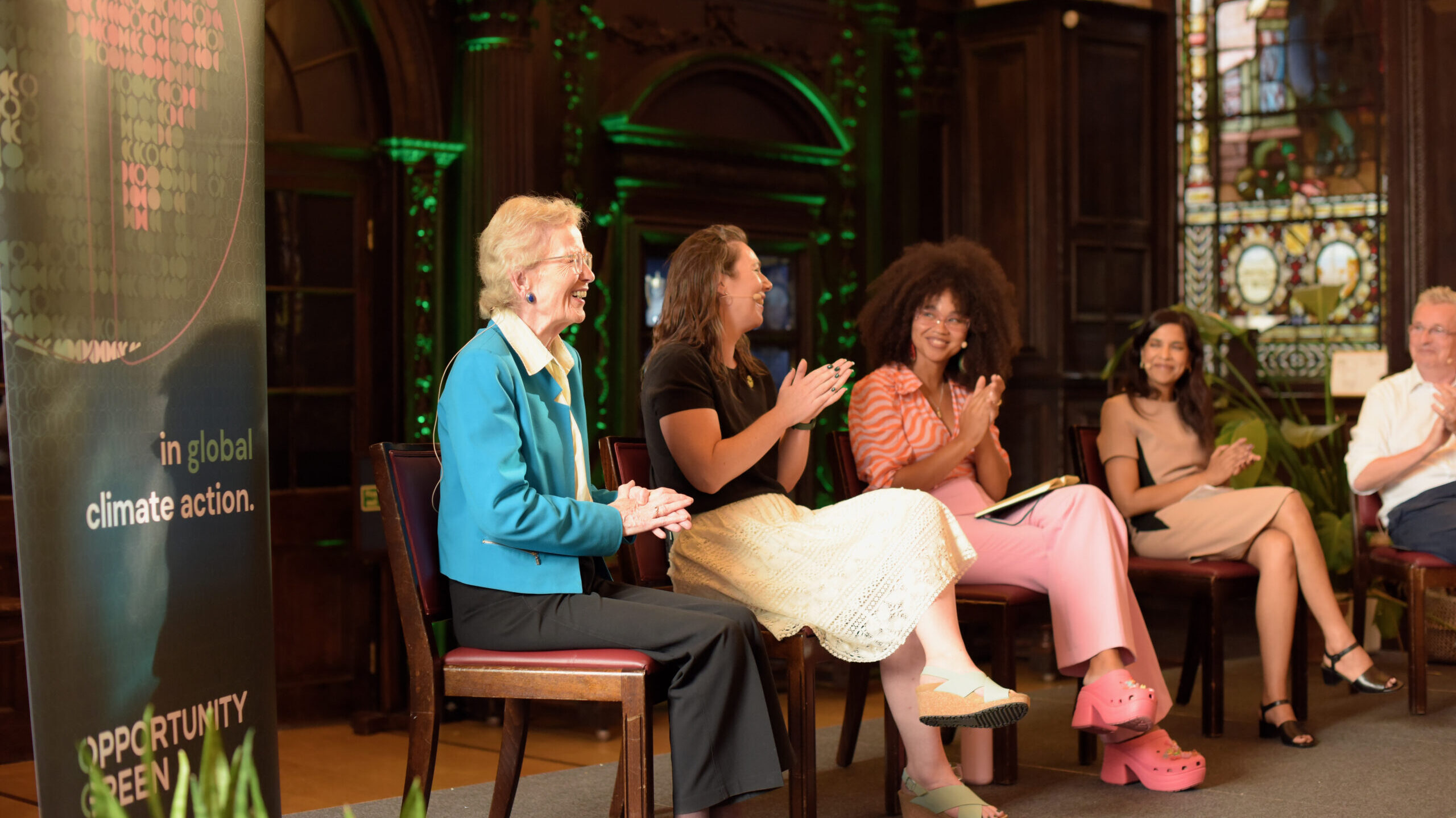
As Opportunity Green celebrates five years of working to tackle climate change, it felt like the right moment to pause and reflect on the people and ideas that inspire us to keep pushing for change.
I was delighted to be joined by:
- Mary Robinson, first woman President of Ireland; co-founder of Project Dandelion, a women-led global campaign for climate justice; and founding member of The Elders, an independent group of global leaders founded by Nelson Mandela.
- Tessa Khan, climate change lawyer, campaigner and founder of Uplift, an organisation working towards a rapid and fair transition away from oil and gas in the UK.
- Mikaela Loach, bestselling author, climate justice organiser and speaker, named one of the most influential women in the climate movement by Forbes, The Guardian and Vogue.
- Paul Dickinson, co-founder of CDP, a global non-profit that uses environmental data disclosure to drive companies, cities and investors toward sustainable environmental boundaries, and co-host of the Outrage + Optimism podcast, who expertly moderated the discussion.
This evening was an absolute career highlight for me, not just because I got to sit on a panel with my absolute hero, Mary Robinson, but because the wider discussion really reminded me what a privilege it is to do the work we do. Mikaela really put things in perspective against how long many have been campaigning for racial justice. And Tessa brought home that yes, it’s hard, but how could we not be hopeful in the face of everything we need to save.
Watch the panel discussion and read my five key takeaways below.
Key takeaways
1. Climate action must put justice first
Climate change is often framed as an environmental issue, but our panel argued it’s fundamentally about justice. At Opportunity Green, this idea is at the heart of our work. We work alongside climate vulnerable countries, providing legal, policy and technical support to help amplify their voices in global decision-making. (You can read more about our climate justice work here.) It was great to hear the other panellists reflect on why climate justice is central to their work too.
Mary Robinson reflected on how her understanding of the climate crisis changed while serving as United Nations High Commissioner for Human Rights. During visits to communities in Africa, she met women whose livelihoods had become increasingly uncertain as the rains no longer came when they were expected. Those conversations made her realise that climate change was becoming the defining human rights challenge of our time – not simply an environmental problem, but one that threatens people’s rights, dignity and ability to provide for their families.
This perspective was echoed throughout the discussion. Tessa Khan spoke about the importance of a just transition that supports workers and communities as economies move away from fossil fuels. Michaela Loach explained how her route into climate organising came through migrant justice and racial justice. The message was clear: climate solutions not only need to cut emissions but also improve people’s lives.
2. Real change starts from the ground up
Michaela Loach’s mushroom analogy has really stayed with me. Reflecting on how social movements create lasting change, she compared them to mushrooms. While the mushroom is the visible result, it is sustained by mycelium, an underground network that quietly grows, connects and supports life beneath the surface. Climate movements, she argued, work in the same way. The wins we celebrate are only possible because of years of organising, relationship-building and community work that often goes unseen. When things feel like they’re not moving, it’s important to remember there’s so much happening in the background that we don’t see. Then one day, it all comes together to form a beautiful mushroom.
Mary Robinson echoed that idea through her experiences with communities already living on the frontline of climate change. She described women as the “infrastructure” of their communities, supporting families and responding to climate impacts every day. The challenge, she argued, is to recognise and support that leadership, rather than assuming solutions will always come only from the top down.
3. Today’s wins are built on years of persistence
Tessa Khan reflected on how dramatically the conversation around fossil fuels has changed in a just a few years. Policies and legal wins that once felt out of reach are now becoming reality – not because change happened overnight, but because civil society kept pushing. She said she felt fortunate to be part of a movement that has already achieved so much, thanks to the work of those who came before.
Mary Robinson also reflected on her time as the UN Secretary-General’s Special Envoy on Climate Change in the lead-up to the Paris Agreement. She recalled arriving in Paris with no agreement in sight and a low mood in the room. But after a hard fight led by climate vulnerable countries, the 1.5°C goal was finally secured in the second week. The emotion when the breakthrough came, she said, was enormous. Years later, the International Court of Justice’s advisory opinion – driven by the efforts of Pacific island states and young campaigners – has strengthened that political commitment into a legal one – reminding us that progress is built over time, with each hard-fought victory creating the foundation for the next.
For me, resilience often comes down to something quite simple: turning up again and again. Progress rarely follows a straight line, but it does build over time.
4. Backlash is a sign you’re making progress
Changing systems means challenging powerful interests, and that often comes with resistance. I shared a story from Opportunity Green’s early days, when we challenged greenwashing in the shipping sector. At the time we were a team of just a handful of people, so receiving legal threats from major shipping companies was intimidating. But once the initial panic had passed, I realised it also meant our work was making an impact. If organisations with that much power felt the need to respond, we were asking the right questions.
Tessa Khan echoed that point, arguing that backlash is often a sign you’re making progress. When powerful interests begin to resist, it’s often because the pressure for change is starting to work.
5. Action creates hope
We ended the conversation by talking about hope. Tessa Khan admitted that she doesn’t always feel hopeful. Some days she’s angry, some days frustrated, but she doesn’t think hope has to come first. You can still choose to act, and often it’s through acting that hope begins to grow.
Mikaela Loach spoke about drawing strength from the generations of people who fought for justice before us, while Mary Robinson reminded us that we all have a duty to our communities. Their message wasn’t that climate action is easy. It was that hope comes from knowing you’re part of a much bigger movement, and from continuing to show up.
My final reflections on the event
The evening was everything I had hoped for. I left feeling a renewed sense of inspiration and determination to keep fighting, even against all the vested interests lined up against us. It really spoke to OG’s position in the ecosystem too: focused on the sectors where emissions are not yet coming down yet, but where a small but mighty NGO like OG can make a difference!
Watch the video directly on YouTube.