
1. Story of the month: New projects advance the shift to cleaner shipping fuels – James Kershaw
As Member States prepare to discuss the future of shipping’s energy transition at the International Maritime Organization (IMO) in November, two recent projects show how the supply of alternative fuels is beginning to develop.
Decarbonising the biggest ships which transport goods across vast distances will require new fuels. Of these, the most scalable, sustainable options are “e-fuels”, made using green hydrogen. Green hydrogen is made by electrolysis of water using renewable electricity, and can either be used as a fuel itself or as a feedstock for fuels like e-ammonia and e-methanol. Shipping’s energy transition will rely heavily on these e-fuels, which can provide both deep emissions reductions and more sustainable production processes than crop-based biofuels.
Today’s supply of e-fuels remains limited, making recent developments particularly significant. The PosHYdon project in the North Sea has produced green hydrogen for the first time on an operational offshore platform, using electricity from offshore wind. Meanwhile, construction has begun on India’s first port-based e-methanol plant, which is expected to produce 150 tonnes of e-methanol a day.
What’s needed now are policy mechanisms to help scale these positive steps into global action across the sector. When IMO Member States meet next month, they have the chance to implement exactly that, by adopting an ambitious and fair Net Zero Framework.
Check out our work on alternative fuels and learn more about the SASHA Coalition.
2. Germany publishes first roadmap to phase out fossil fuels
For the first time, Germany, Europe’s biggest economy, has published a roadmap for phasing out fossil fuels, with the target of ending their use by 2045.
The roadmap marks Germany’s first explicit plan for transitioning away from fossil fuels. Its previous pledges were only for carbon neutrality.
The plans include increasing renewable energy from 55% to 80% of electricity generation by 2030. The government also reaffirmed its target of ending coal use by 2038, with the potential for an earlier target of 2035.
Methane – a much more potent greenhouse gas than CO2 – is also on the government’s radar. Germany aims at cutting its methane emissions by 30% by 2030, in accordance with a global methane pledge signed in 2021.
The roadmap comes amid a growing push for cooperation outside the normal COP process. At COP30 in Brazil last year, countries failed to reach consensus on a proposal to launch work on a roadmap for transitioning away from fossil fuels, despite broad support.
In April 2026, 57 countries instead gathered in Columbia for the first international conference dedicated to planning the transition away from fossil fuels. The countries agreed to establish new workstreams on reducing dependence on fossil fuels and strengthening international cooperation. France unveiled its own roadmap at the conference, setting targets to end coal use by 2030, oil by 2045 and fossil gas by 2050.
A second conference is planned for early 2027, co-hosted by Ireland and Tuvalu.
3. EU anti-greenwashing rules come into force
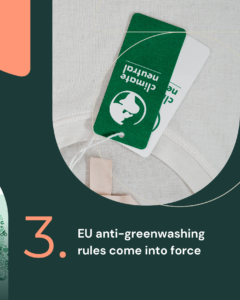
The new EU rules against greenwashing (introduced by the Empowering Consumers for the Green Transition Directive) entered into application on 27 September 2026.
The Directive was designed to strengthen rules against greenwashing and restore consumers’ confidence in marketing.
Under the newly applicable rules, as transposed by Member States, generic, unsubstantiated claims such as “green” and “environmentally friendly” are blacklisted unless backed by recognised excellent environmental performance. Environmental claims need to be clear and substantiated with reliable evidence.
Self-created eco-badges and eco-labels are also banned. All sustainability labels must now be based on a certification scheme or established by public authorities.
Claims of carbon neutrality based on the purchase of carbon offsets are similarly prohibited. Instead, such claims must be based on the product’s actual lifecycle impact rather than offsetting emissions outside its value chain.
Companies that break the rules can face fines of up to 4% of their annual turnover.
This is a major and necessary clampdown on greenwashing in the EU, following Commission estimates that currently, 53% of green claims give vague, misleading or unfounded information; 40% of claims have no supporting evidence; and half of all green labels offer weak or non-existent verification.
Our Legal Manager, Matilda Graham says:
In a welcome development, the new rules ensure that consumers across the EU will have access to reliable, transparent and verifiable information on the environmental characteristics of products, supporting them to make genuinely greener choices.
4. France imposes fees on ultra-fast fashion items
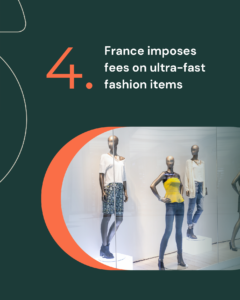
France has introduced an environmental malus (financial penalty) on ultra-fast-fashion clothing to regulate the industry, targeting companies such as Shein, Temu and AliExpress. The law came into force on 1 September, 2026.
Under the new law, ultra-fast fashion is identified according to the volume of clothing placed on the market and the cost of repairing clothes relative to their purchase price. The per-item fee will depend on how each product scores on both standard.
For 2026, the malus ranges from €0.50 (£0.43) for underwear to €2 (£1.71) for T-shirts, €9 (£7.71) for jeans and €12 (£10.28) for a jacket.
The malus could reach up to €19.50 (£16.71) per item by 2030, though the cap remains at 50% of the product’s pre-tax price.
The charge is paid by the companies putting the products on the French market, rather than directly by consumers, although companies could choose to pass some or all of the cost on through higher prices.
France will also ban advertising for ultra-fast-fashion products and brands from January 2027. The ban will extend to influencers, who will be prohibited from promoting ultra-fast-fashion products or brands, with violations carrying fines of up to €100,000.
France’s move comes as the EU is also tightening rules around textile waste. Since July, large companies have been banned from destroying unsold clothes, shoes and accessories. Earlier this month, Bristol also became the first British city to ban advertisements for fast fashion.
These are significant first steps given the environmental footprint of fashion. The textile industry is estimated to account for 2–8% of global greenhouse gas emissions, while using the equivalent of 86m Olympic-sized swimming pool of water each year.
5. Renewables supplied a record 80% of Australia’s main electricity grid
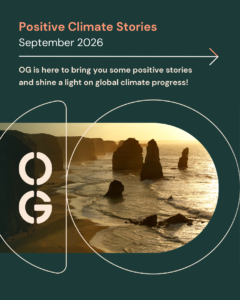
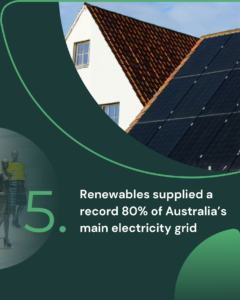
Solar and wind helped set a new renewable energy record in Australia, with renewables supplying 80.4% of electricity demand on the National Electricity Market (NEM) for 30 minutes on 19 September.
Rooftop solar alone met more than half the demand on the NEM, which supplies the eastern states, South Australia and the Australian Capital Territory. Solar and wind together supplied most of the remaining electricity, with hydro contributing around 1%, while coal and gas together accounted for about 20%.
The record was helped by clear, sunny weather and relatively low demand for heating and cooling, but it also reflects Australia’s growing renewable capacity. Renewables supplied an average of 44% of the NEM’s electricity in the year to June.
More than 4.3m Australian households have rooftop solar, helping to reshape the country’s electricity system. In the June quarter, average wholesale electricity prices fell 47% year-on-year, their lowest level for that quarter since 2020.