

In October last year the United States led a coalition of countries to block the adoption of the IMO’s Net-Zero Framework. Among the principal reasons, issued in a US Department of State press release: “President Trump has made it clear that the United States will not accept any international environmental agreement that unduly or unfairly burdens the United States or harms the interests of the American people.”
On the face of it, not wanting to bear a disproportionate cost of implementing global regulation may not appear unreasonable – and this is a fear shared by many Member States. But that perspective ignores the US’s contribution to both historic and current emissions and disregards the fact that the price of climate change is already being paid – the costs are simply being born by those least able to afford it.
The true cost of implementing the Net-Zero Framework to the US
In new analysis – summarised in the image below – expanding on Opportunity Green’s recent briefing on the costs of inaction compared to the cost of implementing the framework, we look specifically at the US.
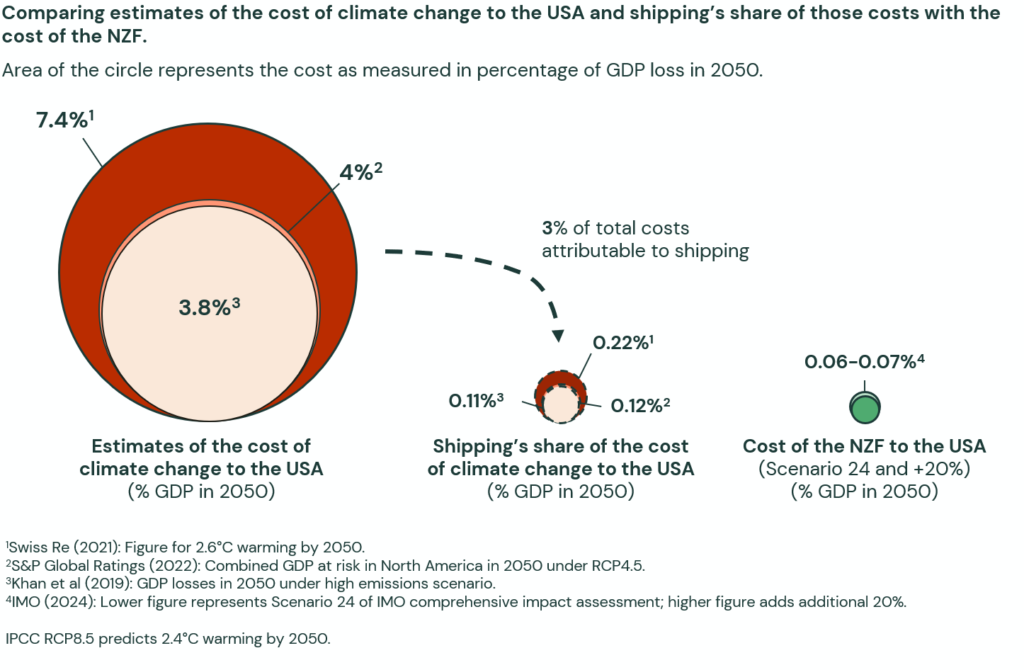
What this analysis shows is very clear. Studies on the economic impacts of climate change estimate that the effects attributable to the shipping sector could amount to 0.22% of US GDP. However, the cost of implementing the Framework – according to the IMO’s own estimates – is projected to be just 0.06-0.07% of US GDP.
Even only taking account of these numbers, climate change is more costly to the US than an effective and equitable global regulation. Historic emissions have already cost the US more than any other country ($281bn).
But this isn’t telling the whole story – recent research suggests that earlier studies may have underestimated the macroeconomic costs of climate change by a factor of six. Many of these economic impacts are also expected to intensify beyond the 2050 time horizon considered in our analysis. They also exclude the catastrophic impacts associated with crossing climate tipping points.
The maritime transition will bear a cost (and one that shipping should be well-placed to pay, judging by the sector’s mega profits in recent years), but adopting international regulation is also a huge opportunity to invest in cleaner fuels, strengthen energy security, create new industries and support economic development.
This is not a choice between economic prosperity and climate action. This analysis demonstrates a clear case for adopting the Net-Zero Framework – climate action on shipping is cheaper than inaction, and it will serve American voters as much as the climate vulnerable countries it is designed to protect. If the US truly wants to put America first, it should adopt the Net-Zero Framework and help deliver a just and equitable transition for global shipping.