

Download documents
Download briefingBackground
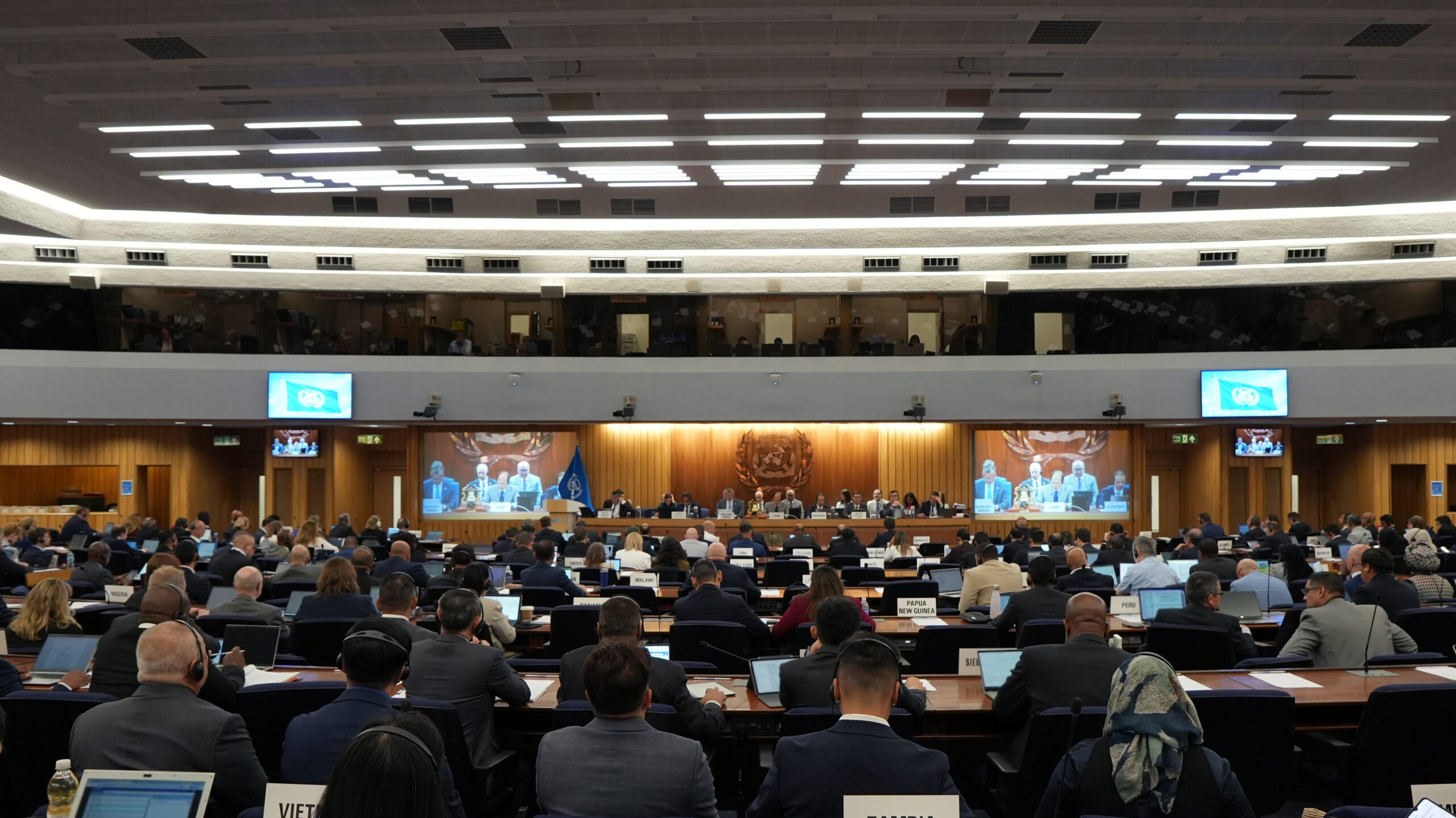
The April 2026 IMO meetings are a critical test for shipping’s net-zero transition. Decisions taken at both the 21st Session of the Intersessional Working Group on Reduction of Greenhouse Gas Emissions from Ships (ISWG21) and the 84th Session of the Marine Environment Protection Committee (MEPC84) will shape investment, equity and the sector’s ability to deliver meaningful emissions reductions.
This briefing provides a synthesis of submissions made to the IMO. Some summaries are accompanied by Opportunity Green’s analysis or context.
The upcoming IMO meetings will be decisive in shaping the implementation of the proposed Net-Zero Framework, as discussions advance on the core design elements of its accompanying technical guidelines.
At ISWG21, focus will be on the Net-Zero Fund, GHG Fuel Intensity (GFI) framework, zero- and near-zero fuel (ZNZ) definitions and rewards, and the Life Cycle Assessment framework – key elements for environmental integrity, equity, investment signals and implementation.
At MEPC84, a central question is whether the NZF continues towards adoption as it was approved in April 2025 or is weakened, including through the removal of its economic element. The choice between tacit and explicit acceptance will also be critical in determining the speed and effectiveness of implementation.
The scale of the problem
Global shipping currently accounts for around 3% of GHG emissions every year. The International Maritime Organization has developed the Net-Zero Framework (NZF) to reduce these emissions, following its 2023 GHG Strategy.
The NZF in its current form represents a significant compromise by Member States from initial more ambitious proposals after years of detailed discussions. While this is not without its limitations, it remains the only option currently on the table capable of providing the strong signal needed to drive investment in sustainable fuels and a firm foundation to increase future ambition and achieve a just and equitable transition for climate vulnerable countries. Any further delay, or weakening of the Framework, would cause regulatory uncertainty and allow emission to continue unabated.
What’s covered in the briefing?
- Overview of the April 2026 IMO meetings: why these discussions are a key moment for shaping the Net-Zero Framework.
- MEPC84 decision points: what is at stake in adopting the Framework, including risks of weakening key elements and delays to implementation.
Summaries and analysis of submissions to the IMO on the following topics:
- GHG Fuel Intensity framework: key design and implementation challenges that will affect how emissions are measured and regulated.
- Zero- and near-zero fuels: debates on definitions and reward mechanisms that will determine which fuels are incentivised and scaled.
- Life Cycle Assessment Guidelines: unresolved methodological issues with implications for environmental integrity and consistency across fuels.
- The Net-Zero Fund: establishment and governance arrangements that will shape how the fund is managed, and considerations for how its revenues will be disbursed.
Em Fenton, Senior Director, Climate Diplomacy says:
“The IMO Net-Zero Framework is not just a climate measure – it’s a test of whether international cooperation can survive in an era of increasing geopolitical pressure. A majority of the world’s nations want this to succeed. Opposition may be loud, but that doesn’t mean it will drown out the voices for ambition and justice, many of whom come from communities most greatly affected by climate impacts. We must remember that what happens at these IMO meetings matters far beyond the shipping industry. It will determine whether billions of dollars in revenue reaches the countries, communities and zero emission technology projects that need it most, accelerating an equitable transition for all.”
Authors
- Co-authors: Sapphire Ross and Maudie Fraser