

1. Story of the month: A step towards tackling aviation emissions through airport caps – Olivia Moyle, Legal Officer
In a positive step for climate action in aviation, the Court of Justice of the European Union confirmed this month that airport coordinators must respect legally binding limits, such as passenger capacity caps, when allocating airline take-offs and landing slots.
The judgment centred on whether the rules for allocating annual airline slots require coordinators to take legal limits on airport capacity into account. The court provided a broad definition, finding coordinators must consider a wide range of relevant factors – regardless of whether they are political, legal or physical in nature, or whether they reflect measures which are long-standing or where there has been subsequent evolution.
This understanding has been long-opposed by airlines, who contend that restrictions on airport capacity cannot be reflected in slot allocation, which has led to instances of unchecked aviation growth at European airports, such as in Dublin. This has been refuted by the courts.
This ruling gives governments across Europe a clearer legal basis for enforcing airport capacity caps and bring aviation emissions down at the airport level.

2. Australia’s highest court upholds the rejection of a major coal mine expansion
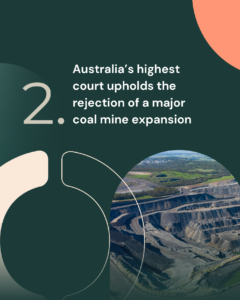
Australia’s highest court has upheld the rejection of a major coal mine expansion in New South Wales, in a landmark ruling.
The proposed expansion of the Mount Pleasant coal mine would have allowed an additional 406m tonnes of coal to be extracted and extended operations until 2048.
Most of the resulting emissions would have come from burning the exported coal overseas. The court ruled that planning authorities must consider these emissions when assessing the climate impacts of fossil fuel projects.
This could have wider implications for future coal and gas developments in Australia, one of the world’s largest fossil fuel exporters.
3. Giant tortoises outnumber people in the Seychelles after decades of protection
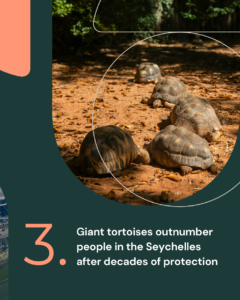
There are more wild Aldabra giant tortoises than people in the Seychelles, according to a new study. The Seychelles Islands Foundation and the University of Exeter estimate that around 180,000 giant tortoises live on Aldabra Atoll – more than the country’s human population of around 123,000.
It is the largest population estimate ever recorded for the species, which survives in the wild in only two places: Aldabra and the Galápagos Islands.
The species was once pushed to fewer than 1,000 individuals by heavy exploitation in the 19th century. Decades of protection have helped the population recover, with Aldabra becoming a strict nature reserve in 1981 and a UNESCO World Heritage Site in 1982.
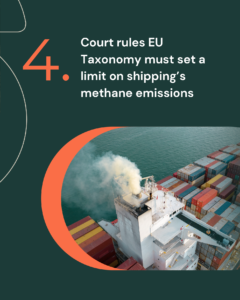
4. Court rules EU Taxonomy must set a limit on shipping’s methane emissions
A legal challenge by Opportunity Green and its coalition partners has secured an important climate win: the EU General Court has ruled that part of the EU’s sustainable investment criteria for shipping is unlawful because it fails to set a measurable limit on methane emissions from ships.
The ruling means the European Commission must address this gap in the EU Taxonomy, which guides investors towards activities classified as sustainable. It is a significant step towards ensuring that investments in polluting ships cannot be labelled sustainable without properly accounting for their climate impact.
The decision is particularly important for ships powered by liquefied natural gas (LNG). Although LNG is often promoted as a cleaner transition fuel, unburned methane – a gas around 82.5 times more potent than CO2 over a 20-year period – can escape into the atmosphere. The Commission must now address this gap.
The ruling also sends a strong signal beyond the shipping sector: gas is not a clean transition fuel. Its climate impacts, including highly damaging methane emissions, cannot simply be ignored.
David Kay, Legal Director at Opportunity Green, said:
“This ruling is a crucial confirmation that the European Commission’s discretion is not a blank cheque and remains strictly bound by the rules of the Taxonomy Regulation.”
However, the win was only partial. The Court did not reject the aviation criteria or other elements of the shipping criteria, meaning fossil-fuelled planes and ships can still be labelled as sustainable investments. Opportunity Green and its coalition partners are reviewing the judgment and considering whether to appeal these remaining gaps.
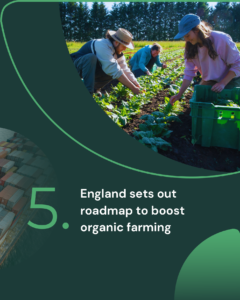
5. England sets out roadmap to boost organic farming
England has published its first Organic Action Plan, setting out how the government and farming sector will work together to grow organic food production over the next decade.
Around 3.4% of England’s farmland is currently managed organically. The plan sets an ambition to increase this share towards 10% by 2036, with measures to help farmers switch to organic production, strengthen supply chains and make it easier for consumers to buy organic food.
Organic farming can help support healthier soils, wildlife and cleaner water, while reducing reliance on synthetic fertilisers and pesticides. It can also help farms become more resilient to drought and flooding.
The plan is a step towards expanding organic farming in England, although its environmental benefits will depend on how the measures are put into practice.